How to Price an Online Course: A Framework That Doesn't Leave Money on the Table
Use a value-based framework to price your online course, choose between one-time and payment plans, test prices, and offer tiers without underselling.
Pricing is one of the hardest decisions for course creators. Charge too little and you undervalue your work, attract less committed students, and struggle to fund marketing and support. Charge too much without proof and nobody buys. The good news is that pricing isn’t a guess; it’s a decision you can make with a clear framework and refine with data.
Key takeaways
- Price based on the value of the outcome, not the length of the course.
- Consider your audience’s budget and alternatives.
- Use tiers and payment plans to serve different buyers without discounting.
Step 1: Define the outcome
People don’t buy hours of video; they buy transformations. Write down the specific result a student can achieve:
- “Land your first three freelance clients.”
- “Edit YouTube videos twice as fast.”
- “Pass the certification exam on your first try.”
- “Launch a profitable Etsy shop.”
The clearer and more valuable the outcome, the higher the price you can justify.
Step 2: Estimate the value of that outcome
Ask what achieving the result is worth to your student. Some outcomes have a direct financial value, such as a higher salary or new clients. Others save time, reduce stress, or help achieve a personal goal. A course that helps someone earn thousands of dollars can reasonably cost hundreds. A course on a hobby skill will usually sit lower.
A common rule of thumb is to price at a fraction of the value delivered so the purchase feels like an obvious win.
Step 3: Look at the alternatives
What else could your student do to get the same result?
- Free content on YouTube and blogs (cheap, but scattered and time-consuming)
- Books (inexpensive, but no feedback)
- Competing courses (compare depth, support, and reputation)
- One-on-one coaching or a college class (more personal, much more expensive)
Your course should be positioned between these options based on what it uniquely offers: structure, community, feedback, templates, or your particular expertise.
Step 4: Factor in your audience
A course for business owners or professionals can usually command higher prices than one for students or hobbyists. Look at what your audience already buys. If they regularly pay for software, conferences, or coaching, they’re used to investing in results.
Common price ranges
| Course type | Common range | Characteristics |
|---|---|---|
| Mini-course | $29–$149 | One specific skill, self-paced, short |
| Signature self-paced course | $199–$999 | Complete system, templates, community |
| Cohort or live program | $500–$3,000+ | Live sessions, feedback, accountability |
| Premium coaching hybrid | $2,000+ | Course plus direct access to you |
These are general market ranges, not rules. Some excellent courses sit above or below them.
Step 5: Choose a pricing structure
One-time payment
Simple and clear. Students pay once for lifetime or long-term access.
Payment plans
Splitting the price into three to six installments makes higher-priced courses accessible. It’s common to charge slightly more in total for payment plans to cover the added risk and processing fees.
Tiers
Offer two or three versions:
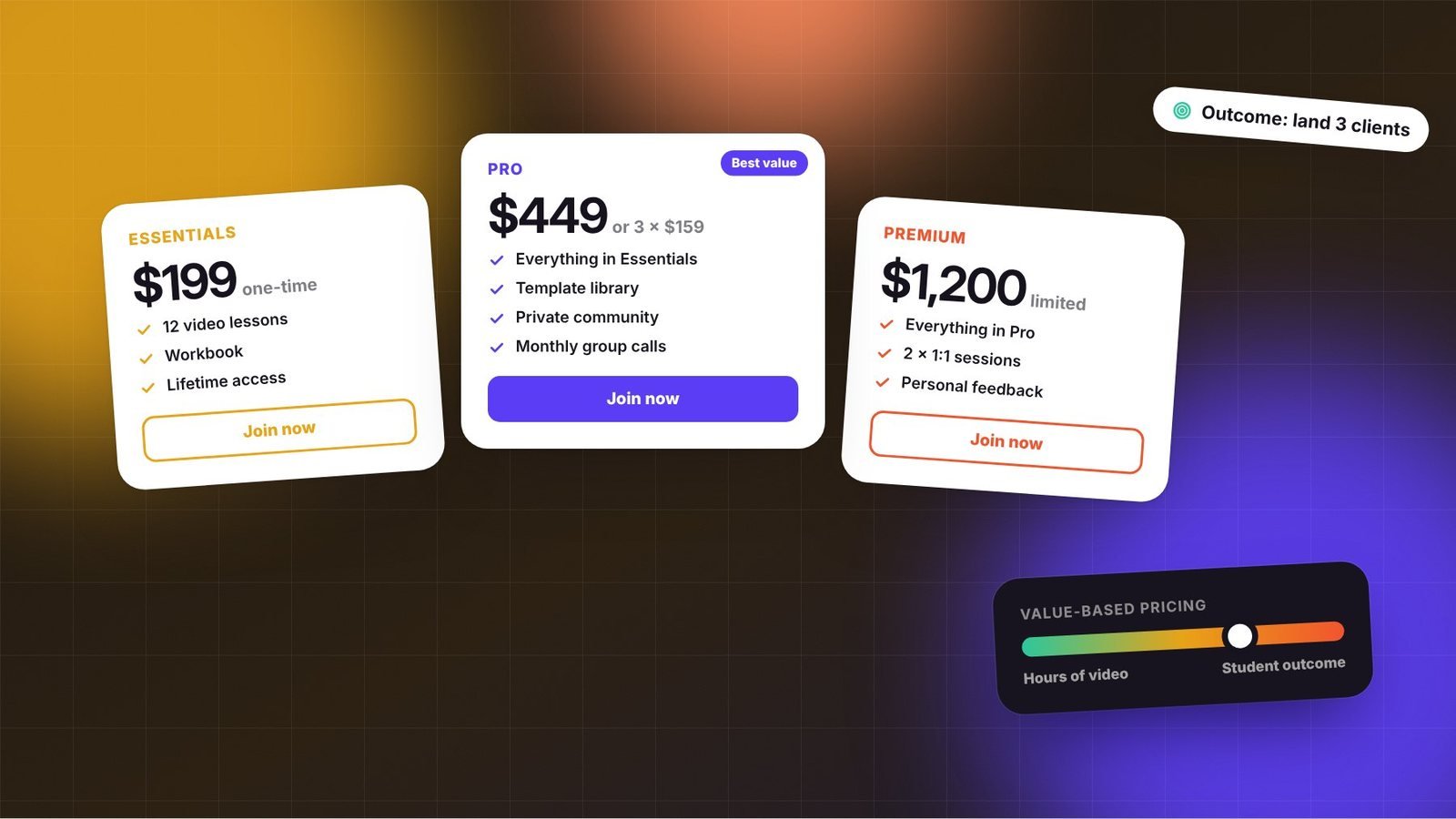
- Essentials: course content only.
- Pro: course plus templates, community, or group calls.
- Premium: everything plus personal feedback or one-on-one sessions, with limited spots.
Tiers let price-sensitive buyers get in while giving committed students a way to get more help. Many buyers choose the middle option.
Step 6: Test and adjust
- Launch with founding pricing. Offer a lower price to your first group in exchange for feedback and testimonials, then raise it.
- Watch conversion and refunds. High conversion with no objections may mean you’re underpriced. High refund rates may signal a mismatch between promise and delivery.
- Raise prices as you add proof. Testimonials, case studies, and results justify higher prices.
Discounts: use them carefully
Frequent discounts train your audience to wait. Instead of slashing price, consider time-limited bonuses, such as a live Q&A or extra templates, for people who join during a launch. If you do discount, keep it rare and predictable.
Pricing mistakes to avoid
- Pricing based on hours of content instead of results.
- Copying a competitor’s price without matching their reputation or support.
- Apologizing for your price in your marketing.
- Never revisiting your price once you have proof.
Pricing is part of positioning. A confident, well-justified price tells students your course is worth their time and attention. Not sure which format to build? Read cohort-based vs. self-paced courses.
Frequently asked questions
Should I price my first course low?
A modest founding price can help you get early students and testimonials, but don’t underprice permanently. Communicate that the founding price is temporary, then raise it as you add proof and improvements.
Are payment plans a good idea?
Yes, especially for higher-priced courses. Payment plans make courses more accessible. Many creators charge slightly more overall for payment plans to cover processing costs and the risk of missed payments.
How do I know if my course is underpriced?
Signs include very high conversion rates, no price objections, buyers saying it’s a bargain, and strong student results. If you see these, test a higher price on your next launch.