How to Plan a Product Launch Email Sequence That Sells
A day-by-day product launch email sequence for creators, with what to send before, during, and after cart open to sell courses, templates, and memberships.
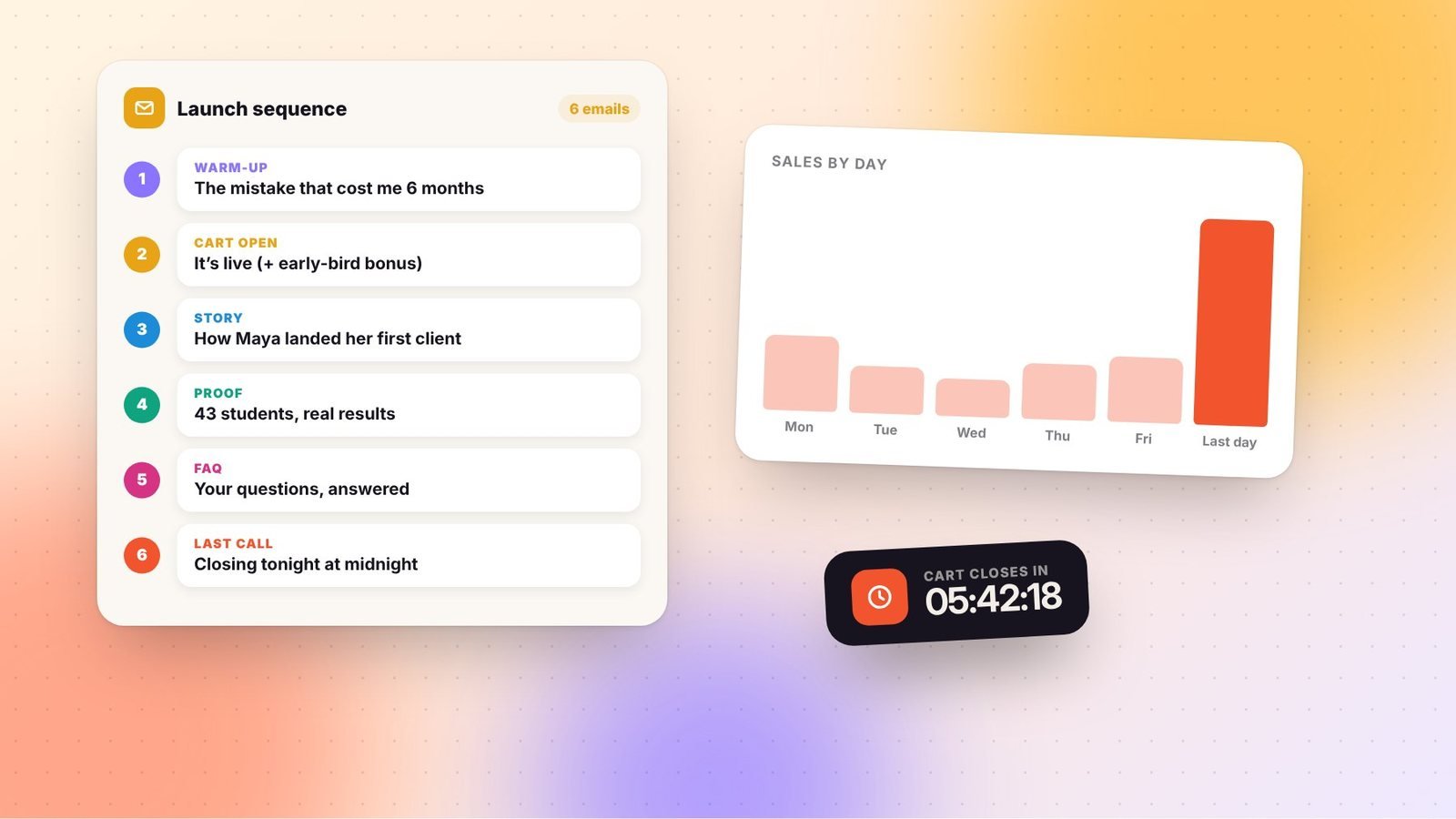
A single “It’s live, buy now!” email rarely sells much. People need time to understand an offer, see how it helps them, and overcome doubts. A launch email sequence spreads that process over several days, with each email doing a specific job.
This guide lays out a proven structure for launching courses, templates, memberships, or other digital products to your email list.
Key takeaways
- Warm up your list with helpful content before you open sales.
- Each launch email should have one job: educate, announce, prove, answer, or remind.
- A real deadline is honest and motivates action.
The launch timeline at a glance
| Phase | Timing | Goal |
|---|---|---|
| Warm-up | 1–2 weeks before | Educate and build interest in the problem |
| Open cart | Day 1 | Announce the offer and early-bird incentive |
| Middle | Days 2–5 | Proof, stories, objections, FAQ |
| Close | Final 48 hours | Reminders and last chance |
| Post-launch | After close | Onboard buyers, thank everyone else |
Phase 1: Warm up (1–2 weeks before)
Send two or three valuable emails on the problem your product solves, without selling. Share a lesson, a story, or a quick win. This primes readers to think about the problem and reminds them you’re the person to help.
At the end of the last warm-up email, mention that something is coming and invite interested readers to join a waitlist or click a link to be notified. Tagging these readers lets you send them extra launch emails while others receive fewer.
Phase 2: Open cart (Day 1)
Your announcement email should include:
- A clear subject line: “[Product name] is open (and a bonus for early joiners).”
- The problem and the outcome the product delivers.
- What’s included, briefly.
- The price and any early-bird bonus or discount, with its deadline.
- One clear button or link.
Keep it focused. Link to your sales page for details.
Phase 3: The middle (Days 2–5)
The middle of a launch is where many sales are won. Send one email per day, each with a different angle:
Story email
Share why you created the product, or a student’s before-and-after story. Stories make the outcome tangible.
Proof email
Share testimonials, results, screenshots, or case studies. Only share real results with permission, and avoid implying typical results that most buyers won’t achieve.
Objection email
Address the most common hesitations: “I don’t have time,” “Is this for beginners?”, “What if it doesn’t work for me?” Answer honestly, including who the product isn’t for.
FAQ email
Compile real questions from replies and DMs, then answer them. These emails often perform surprisingly well because they address exactly what undecided readers are thinking.
Phase 4: Close (final 48 hours)
- 48 hours left: recap the offer and the deadline.
- 24 hours left: a short reminder with the key benefit.
- Final hours: a brief “closing tonight” note.
Many launches see a large share of sales in the final day, so don’t skip these emails. Exclude people who already bought so they don’t receive unnecessary reminders.
Keep deadlines honest. If you say the price goes up or enrollment closes, follow through. Fake urgency erodes trust, and the FTC considers deceptive marketing claims a serious issue.
Phase 5: After the launch
- Buyers: send a welcome sequence with access details, a “start here” step, and a way to get help.
- Non-buyers: send a short thank-you and return to your regular content. Consider asking a one-question survey about what held them back.
- You: review conversion rate, revenue, refund requests, and which emails drove the most clicks.
How many emails is too many?
A typical launch might send eight to 12 emails over about two weeks, including warm-up. That’s more than usual, but launches are temporary. Let readers opt out of launch emails specifically, without unsubscribing from your newsletter entirely. Most platforms support this with a simple “not interested” link that applies a tag.
Launch email checklist
- ☐ Sales page tested on mobile and desktop
- ☐ Checkout tested with a real purchase
- ☐ Buyers automatically excluded from sales emails
- ☐ “Not interested in this launch” opt-out link included
- ☐ Deadline and price change scheduled
- ☐ Welcome sequence for buyers ready
A launch sequence is a conversation with your audience over several days. Educate first, sell clearly, answer honestly, and respect your deadline. If you’re building your first product, start with our 30-day digital product plan.
Frequently asked questions
How long should a launch last?
Many creator launches keep the cart open for about five to seven days. That’s long enough for readers to decide without losing urgency. Shorter flash sales work for small products or existing customers.
Will launch emails cause unsubscribes?
Some unsubscribes are normal and usually come from people who were unlikely to buy. Offering a way to opt out of launch emails specifically helps you keep those readers on your list for regular content.
What if a launch doesn’t sell well?
Review your data: email clicks, sales page visits, and conversion rate. Low clicks suggest the offer or messaging didn’t resonate; low conversion suggests the sales page, price, or proof needs work. Survey non-buyers and improve before relaunching.