Should Creators Form an LLC? Pros, Cons, and How to Set One Up
Learn when it makes sense for a US content creator to form an LLC, what it does and doesn't protect, costs to expect, S corp considerations, and setup steps.
As creator income grows, many people ask whether they should “make it official” by forming a limited liability company (LLC). An LLC can help separate your business from your personal finances and add some legal protection. But it also adds paperwork and costs, and it doesn’t automatically lower your taxes.
This guide is general education for US creators, not legal or tax advice. Rules vary by state, so consult a business attorney or tax professional for your situation.
Key takeaways
- An LLC can limit personal liability for business debts and claims, but only if you keep business and personal finances separate.
- By default, a single-member LLC is taxed the same as a sole proprietorship.
- An S corporation election may reduce self-employment taxes once profits are substantial, but it adds payroll and costs.
Sole proprietor vs. LLC
If you earn money as a creator and haven’t formed a business entity, you’re already operating as a sole proprietor. You report business income and expenses on Schedule C of your personal tax return. It’s simple, but there’s no legal separation between you and your business.
An LLC is a separate legal entity created under state law. It can sign contracts, open bank accounts, and hold assets in its own name.
Benefits of an LLC
- Liability protection: in many cases, your personal assets such as your home and savings are shielded from business debts and lawsuits against the business. This protection has limits; it generally won’t protect you from your own negligence or from personal guarantees you sign.
- Professionalism: some brands and agencies prefer contracting with a business entity.
- Cleaner finances: a separate business identity encourages separate bank accounts and better records.
- Privacy: depending on your state and setup, you may be able to use a registered agent’s address instead of your home address in public filings.
- Tax flexibility: an LLC can elect to be taxed as an S corporation later.
Drawbacks of an LLC
- Costs: state filing fees and, in many states, annual report fees or franchise taxes. These vary widely; some states are inexpensive while others charge significant annual minimums.
- Paperwork: annual reports, registered agent requirements, and possibly publication requirements in some states.
- Discipline required: mixing personal and business money can weaken liability protection.
How LLCs are taxed
By default, the IRS treats a single-member LLC as a “disregarded entity.” You still report income on Schedule C and pay income tax plus self-employment tax on your profits, just like a sole proprietor. Multi-member LLCs are taxed as partnerships by default.
The S corporation election
An LLC can elect to be taxed as an S corporation. You then pay yourself a reasonable salary through payroll, which is subject to payroll taxes, and may take remaining profits as distributions that aren’t subject to self-employment tax. This can produce meaningful savings once profits are high enough to outweigh the extra costs of payroll, bookkeeping, and a separate business tax return.
Where that break-even point falls depends on your income, state, and costs. Discuss it with a CPA before electing. The IRS also expects your salary to be reasonable for the work you do.
When does an LLC make sense?
Consider forming one when:
- Your creator income is consistent and growing.
- You sign brand contracts, hire contractors, or sell products where liability risk exists.
- You want to look more professional to partners.
- You’re planning for a future S corporation election.
If you’re just starting and earning occasional income, operating as a sole proprietor with a separate bank account is often fine for a while.
How to set up an LLC
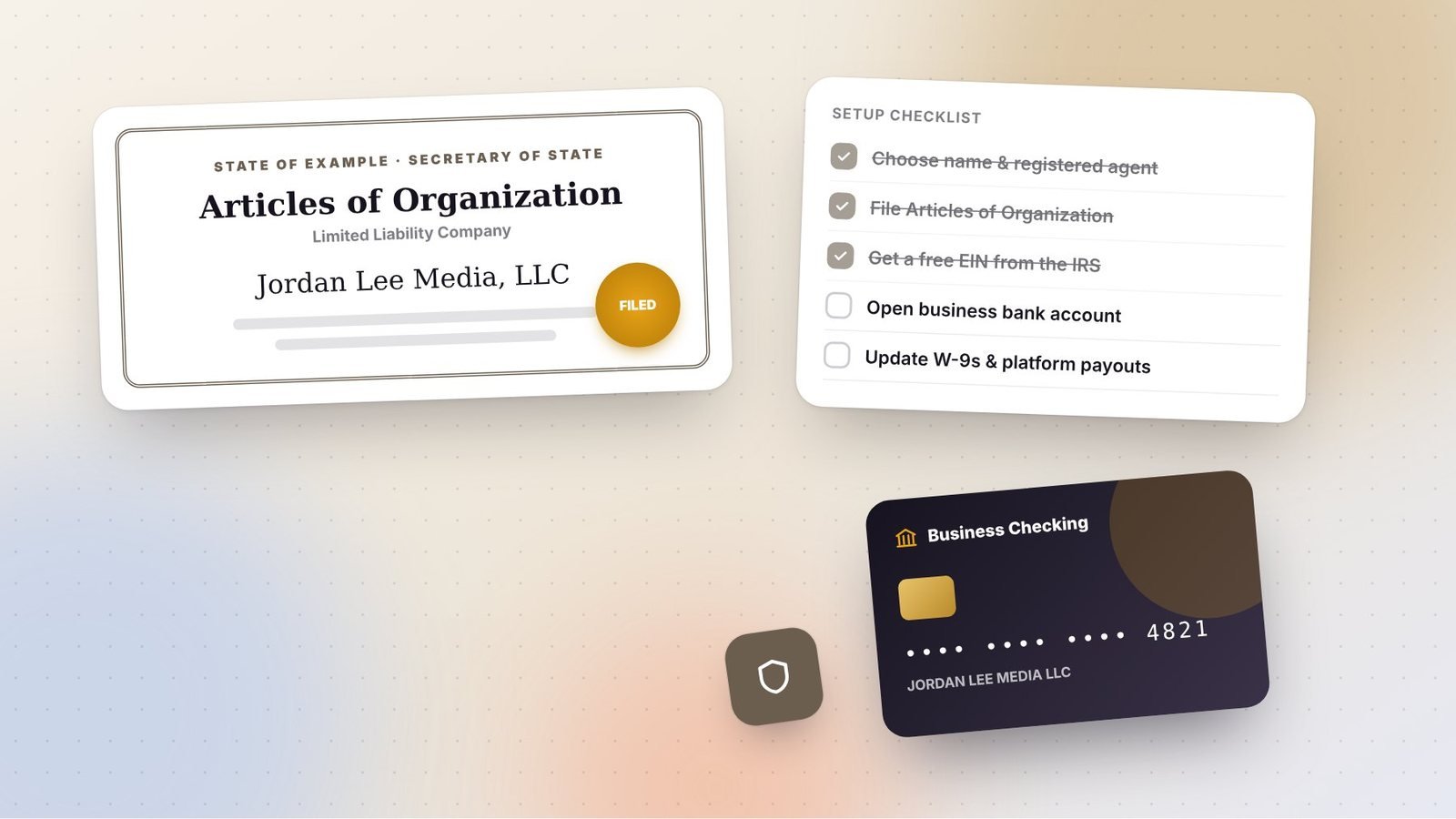
- Choose a name and check availability with your state’s business registry. Also check domain and social handles.
- Choose a registered agent, which can be you or a service, with a physical address in the state.
- File Articles of Organization (sometimes called a Certificate of Formation) with your state and pay the fee.
- Create an operating agreement describing ownership and how the LLC is run, even for a single-member LLC.
- Get an EIN (Employer Identification Number) for free from the IRS website.
- Open a business bank account and use it for all business income and expenses.
- Register for state taxes if required, such as sales tax for physical products.
- Update your accounts: platform payout and tax info, brand contracts, invoices, and W-9 forms.
Most people form an LLC in their home state. Forming in another state usually means registering in your home state as well, which adds cost.
Keep your protection strong
- Never mix personal and business funds.
- Sign contracts in the LLC’s name, as a member or manager of the LLC.
- File annual reports on time.
- Keep good records. Our bookkeeping guide shows a simple monthly system.
- Consider business insurance for additional protection.
An LLC is a useful tool, not a requirement. Choose it when the protection, professionalism, and future tax options are worth the cost. For more on the tax side, read our guide to taxes for content creators.
Frequently asked questions
Does an LLC lower my taxes?
Not by default. A single-member LLC is usually taxed like a sole proprietorship. Tax savings may come from an S corporation election once profits are substantial, but that adds costs and requirements.
Can I form an LLC in a different state?
You can, but you’ll usually need to register as a foreign LLC in your home state if you do business there, which adds fees and paperwork. Most creators form in their home state.
Do I need an LLC to work with brands?
No. Many brands work with sole proprietors. An LLC can add professionalism and liability protection, but it isn’t required to sign sponsorship deals.