How to Find Your Content Niche Without Boxing Yourself In
A practical framework for choosing a content niche that's specific enough to grow fast but flexible enough to evolve with you and your audience.
“Pick a niche” is the most repeated advice in the creator economy, and also one of the most misunderstood. Go too broad and nobody knows why they should follow you. Go too narrow and you burn out, run out of ideas, or cap your growth at a few thousand people. The goal isn’t to find a tiny box to live in forever. It’s to find a clear starting position that lets the right people recognize you quickly.
This guide walks through a repeatable way to choose that position, test it with real content, and widen it over time without confusing your audience.
Key takeaways
- A niche is a promise to a specific person about a specific outcome, not just a topic.
- Validate with 15–20 pieces of content before committing; let data, not guesswork, decide.
- Expand into adjacent topics your existing audience already cares about.
Think “person + problem,” not “topic”
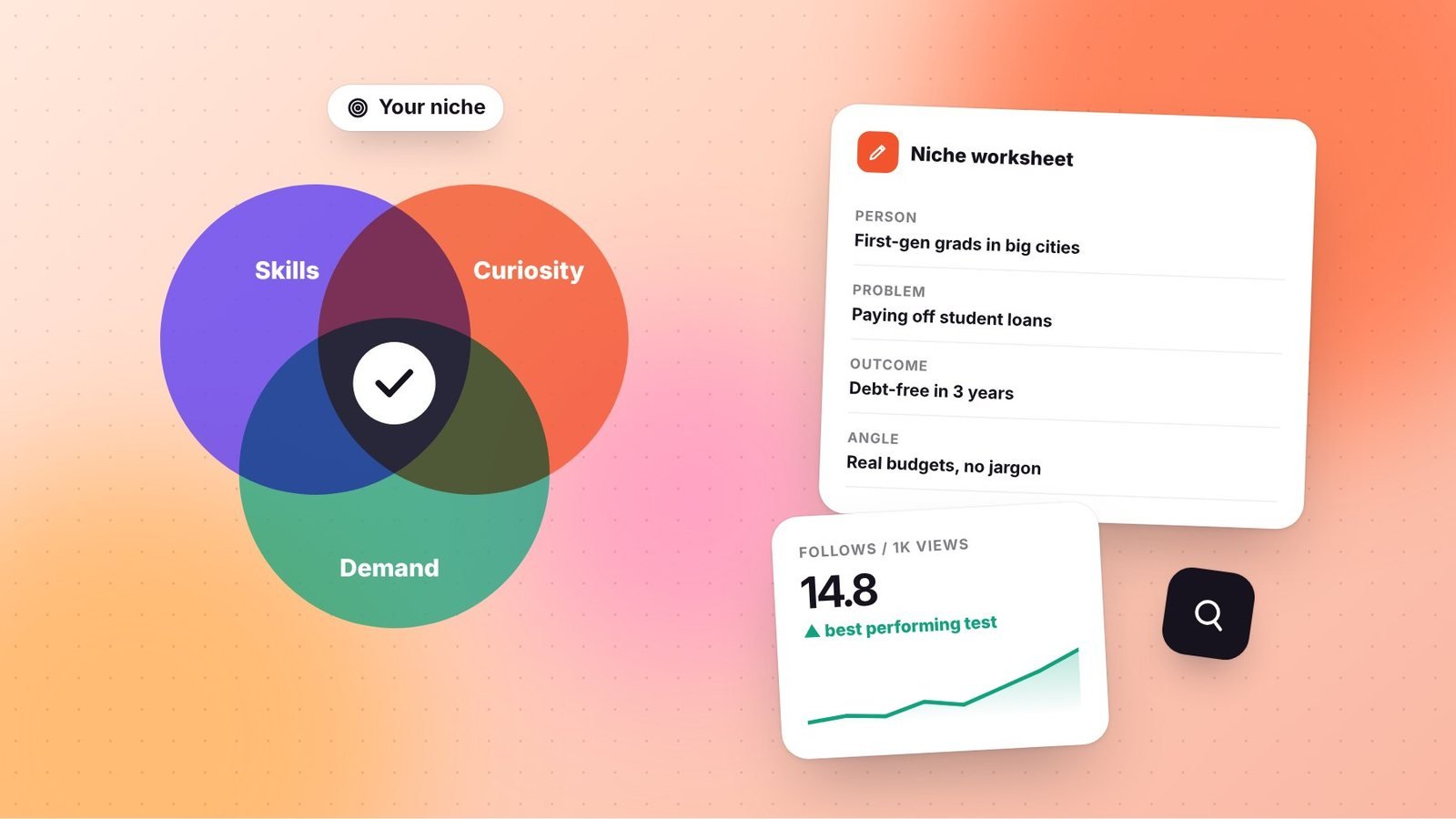
“Personal finance” is a topic. “Helping first-generation college grads pay off student loans while renting in expensive cities” is a niche. The second version tells a reader instantly whether you’re talking to them, and it tells you exactly what to make next.
A useful formula is: I help [specific person] achieve [specific outcome] through [your angle]. Your angle is what keeps you from blending in. It might be your profession (“a nurse explains…”), your format (“5-minute recipes”), your constraint (“on a $50 budget”), or your personality (“no-nonsense,” “nerdy deep dives”).
Step 1: List what you can talk about for years
Start with three quick lists. Spend ten minutes on each, and don’t filter yet.
- Skills: what people already ask you for help with, at work or among friends.
- Curiosities: topics you research for fun, even when nobody is paying you.
- Experiences: problems you’ve personally solved, such as a career change, a health goal, or a business you started.
Circle anything that appears on two or more lists. Those overlaps are your candidates, because they combine credibility with enough interest to keep you creating after the novelty wears off.
Step 2: Check for real demand
Passion without demand is a hobby. Before you commit, look for evidence that people are actively searching for and engaging with your candidate topics:
- Search suggestions: type your topic into YouTube, Google, and TikTok search and note the autocomplete phrases. These are questions real people ask.
- Competitor proof: find three to five creators in the space. If they get consistent engagement, demand exists. Zero competitors usually means zero audience, not an untapped goldmine.
- Community chatter: browse Reddit, Facebook groups, and Discord servers. Recurring questions and complaints are content ideas waiting to happen.
- Monetization signals: are there books, courses, tools, or sponsors in the space? Money flowing through a niche is a good sign you can eventually earn there too.
Step 3: Define your angle
Once you know a topic has demand, decide how you’ll be different. Look at the top creators you found and ask what they don’t do well. Maybe their content is long and you can be concise. Maybe they target beginners and you can serve intermediate learners. Maybe they’re polished and corporate and you can be candid and behind-the-scenes.
| Broad topic | Specific person | Angle |
|---|---|---|
| Fitness | Busy parents | 20-minute home workouts with no equipment |
| Productivity | Freelance designers | Systems built in Notion, shown with real client projects |
| Cooking | College students | Meals under $3 per serving using a microwave and one pan |
| Investing | Early-career nurses | Plain-English explanations of 403(b) plans and benefits |
Step 4: Run a 30-day content test
You can’t think your way to the perfect niche; you have to publish your way there. Commit to 15–20 pieces of content over about 30 days across two or three of your strongest candidate niches. Keep production simple so you can focus on the ideas.
Track a few signals for each piece:
- Retention or read-through: did people stay to the end?
- Saves, shares, and comments: these show value, not just curiosity.
- Follows per view: the clearest sign that people want more from you specifically.
- Your energy: which pieces were you excited to make? That matters more than most people admit.
For help reading these numbers, see our guide to the creator analytics that actually matter.
Step 5: Widen your niche the right way
Once you’ve built a core audience, expansion is natural and healthy. The key is to move into adjacent topics that the same person cares about. A creator who teaches budgeting to new grads can expand into negotiating a first salary, picking health insurance, or buying a first car. The person stays the same; the problems grow with them.
What confuses audiences is jumping to an unrelated person entirely, such as moving from budgeting for new grads to luxury watch reviews. If you want to explore something completely different, consider a separate channel or a clearly labeled series.
Common niche mistakes to avoid
- Choosing purely for money. High-paying niches like finance or software attract great sponsors but also fierce competition. Without genuine interest, you’ll struggle to outlast people who love it.
- Waiting for certainty. No amount of research replaces real audience feedback. Publish first, refine second.
- Defining yourself by platform. “TikTok creator” isn’t a niche. Your niche should survive a change of platform.
- Ignoring your own story. Your background is often the most defensible angle you have, because nobody can copy it.
A quick niche worksheet
Before you publish your next piece, fill in these five lines and keep them somewhere visible:
- The person I serve is…
- The main problem they want solved is…
- The result they want is…
- My angle (why me) is…
- Three adjacent topics I could expand into later are…
Your niche will evolve, and that’s expected. A clear starting position simply makes it easier for the right people to find you, trust you, and eventually pay you. When you’re ready to turn that audience into income, read our breakdown of creator revenue streams ranked by effort and income potential.
Frequently asked questions
Can I have more than one niche?
Yes, but it usually works better to lead with one clear niche until you have a core audience, then expand into adjacent topics. If two interests serve completely different people, consider separate channels or a clearly labeled series so neither audience feels confused about what you offer.
How long should I test a niche before switching?
Give a niche at least 15 to 20 pieces of content over roughly a month before judging it. Early posts are also practice, so look for improving trends in retention and follows rather than one breakout hit. If nothing improves after a few months of consistent effort, test a new angle before abandoning the topic entirely.
Is it too late to start in a crowded niche?
Rarely. Crowded niches prove demand. What matters is a distinct angle, such as a specific audience, format, or perspective that existing creators don’t serve well. Many successful creators entered saturated topics by narrowing the audience first, then widening once they earned recognition.