How to Use AI Tools as a Creator Without Losing Your Voice
A practical guide to using AI for research, outlining, editing, captions, and repurposing while keeping your content original, accurate, and authentically yours.
AI tools can draft outlines, generate captions, clean up audio, transcribe videos, and suggest titles in seconds. Used well, they can save creators hours every week. Used carelessly, they produce bland, generic content that sounds like everyone else and sometimes contains errors that damage your credibility.
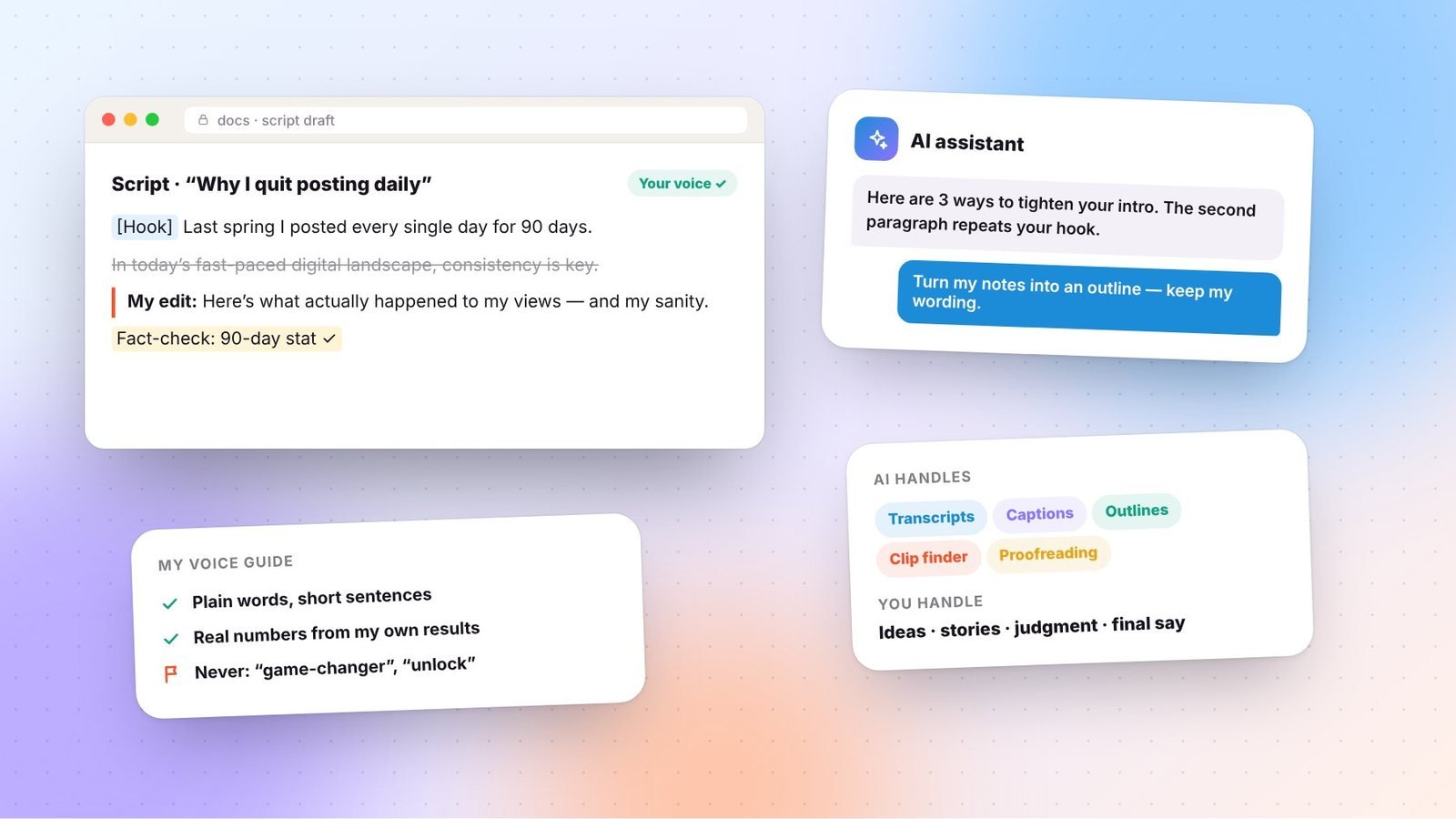
The goal is to let AI handle the repetitive work while you stay responsible for ideas, judgment, and voice.
Key takeaways
- Use AI for structure, speed, and busywork; keep original ideas and experiences human.
- Always fact-check AI output; it can state wrong information confidently.
- Follow platform disclosure rules for realistic synthetic media.
Where AI helps most
Research and ideation
- Brainstorming angles on a topic you already know.
- Summarizing long documents or transcripts you provide.
- Grouping audience comments into themes.
- Generating lists of questions your audience might have.
Treat AI research as a starting point. Verify facts, statistics, and quotes with original sources before publishing.
Outlining and structure
Give AI your rough notes and ask it to organize them into a logical outline. You provide the substance; it helps arrange it.
Editing and polishing
- Catching grammar and clarity issues.
- Suggesting tighter phrasing for long sentences.
- Checking whether an explanation makes sense to a beginner.
Production and post-production
- Transcription and captions.
- Audio cleanup and noise removal.
- Finding highlight moments for short clips.
- Removing filler words and silences in editing tools.
Repurposing
Turning a transcript into a first draft of a blog post, newsletter summary, or social posts. See our repurposing workflow.
Where to keep things human
- Your opinions and stories. Your experiences are what make your content worth following.
- Expert judgment. Advice on health, money, legal, or safety topics needs real expertise and careful sourcing.
- Final decisions. Titles, hooks, and calls to action benefit from AI suggestions, but you know your audience best.
- Community replies. Fans can tell when responses are automated.
A workflow that protects your voice
- Start with your own thinking. Write or record a rough brain dump of your ideas, examples, and opinions first.
- Use AI to structure. Ask for an outline based only on your notes.
- Draft in your words. Write the script or article yourself from that outline, or have AI draft and then rewrite heavily.
- Use AI to critique. Ask what’s unclear, what’s missing, or where a reader might lose interest.
- Fact-check everything. Verify every claim, number, and name against a reliable source.
- Read it out loud. If it doesn’t sound like you, revise it.
Create a short “voice guide” describing your tone, favorite phrases, words you never use, and examples of your best work. Share it with AI tools and human collaborators alike.
Disclosure and platform rules
Major platforms now have policies on AI-generated or altered content. YouTube, for example, asks creators to disclose when realistic content is meaningfully altered or synthetically generated, such as making a real person appear to say something they didn’t. TikTok and Meta platforms label AI-generated content as well. Using AI for scripting help, captions, or color correction typically doesn’t require disclosure, but realistic synthetic people, voices, or events often do. Check each platform’s current rules.
Never use AI to imitate a real person’s voice or likeness without permission, and be careful with AI-generated images of real brands or copyrighted characters.
Copyright considerations
The U.S. Copyright Office has said that works need meaningful human authorship to be protected by copyright, and that purely AI-generated material isn’t copyrightable on its own. Content where you contribute substantial creative choices and editing is in a stronger position. Learn more in our guide to protecting your content.
Common AI mistakes creators make
- Publishing unedited AI drafts. They tend to be generic and repetitive.
- Trusting AI facts. AI can invent statistics, quotes, and sources.
- Feeding sensitive data into tools without checking privacy settings, such as brand contracts or audience emails.
- Over-automating community engagement. Authentic connection is your advantage.
AI is a powerful assistant, not a replacement for your perspective. The creators who benefit most use it to clear away busywork so they can spend more time on the ideas only they can share.
Frequently asked questions
Will using AI hurt my reach?
Platforms generally focus on content quality and policy compliance rather than whether AI helped with tasks like editing or captions. Low-quality, repetitive, or misleading content tends to perform poorly whether or not AI was involved.
Do I have to disclose that I used AI?
It depends on the platform and how AI was used. Realistic synthetic or altered content often requires disclosure, while using AI for brainstorming, captions, or editing usually doesn’t. Check each platform’s current policy.
Can AI write my scripts for me?
AI can draft scripts, but unedited drafts often sound generic and may contain errors. Use AI to organize your own ideas, then write or heavily revise in your own voice and fact-check every claim.